



Frequently Asked Questions

Marketing Automation Integration & Strategy

What are the essential steps to integrate marketing automation into my existing MarTech stack?

The article outlines nine essential steps: integrating marketing automation with dynamic reporting, leveraging middleware, combining tools for personalized emails, examining processes, using prompts and structured workflows, incorporating CRM, AI, and social media, tracking campaigns with call analytics, choosing flexible platforms for two-way sync, and working backwards from desired outcomes. Each step is supported by expert advice and real-world examples. Source

How does dynamic reporting improve marketing automation integration?

Dynamic reporting quantifies the impact of marketing automation, enabling marketers to optimize workflows by identifying what works and what doesn't. Creating a flywheel between automation and reporting processes helps generate strong data points for continuous improvement. Source

What role does middleware play in integrating marketing automation with other technologies?

Middleware acts as a software layer that facilitates communication and data management between technologies. It ensures smooth data transfer and workflow among diverse teams, making integration of marketing automation software with other systems seamless. Source

How can combining tools like ClickUp, Zapier, OpenAI, and Gmail enhance personalized email marketing?

Using a combination of ClickUp, Zapier, OpenAI, and Gmail enables the automation of highly personalized welcome emails at scale. This approach improves brand experience by leveraging onboarding forms and automating personalized messaging for new clients. Source

Why is examining marketing processes important for successful automation integration?

Examining marketing processes helps identify opportunities for automation, ensures seamless data flow, and improves efficiency. Testing and refining these processes lead to accurate results and valuable data, enhancing marketing personalization and campaign effectiveness. Source

How do prompts and structured workflows streamline marketing automation integration?

Prompts and structured workflows map out interactions between technologies like CRM, analytics, and email tools. By establishing clear triggers within automation software, companies ensure smooth collaboration between systems, resulting in efficient and effective marketing processes. Source

What benefits does CRM integration bring to marketing automation?

CRM integration centralizes customer data, automates lead handovers, and enables personalized customer journeys. It ensures seamless tracking of interactions and nurtures relationships with precision, improving sales and marketing alignment. Source

How can AI and predictive analytics enhance marketing automation?

AI and predictive analytics analyze data from marketing automation and CRM systems to provide insights into future trends and customer behavior. This enables marketers to anticipate client needs and tailor campaigns for maximum impact. Source

What is the importance of tracking campaigns with call analytics?

Call analytics allow companies to track the effectiveness of marketing campaigns through phone-call conversions. Analyzing call data helps optimize marketing strategies and target high-converting channels, providing valuable insights into customer interactions. Source

Why should companies choose flexible platforms for two-way data sync?

Flexible platforms enable seamless two-way data sync with key systems, particularly CRM. This centralizes customer data, automates lead handovers, and supports personalized campaigns based on comprehensive insights, optimizing efficiency and aligning with business objectives. Source

How does working backwards from desired outcomes improve marketing automation integration?

Identifying desired outcomes and mapping the customer journey helps pinpoint touchpoints where automation can streamline workflows. This approach ensures that automation is strategically integrated to drive conversions and achieve business goals. Source

What are common challenges companies face when integrating marketing automation?

Companies often face challenges such as data silos, lack of process clarity, difficulty in syncing systems, and ensuring accurate reporting. Addressing these challenges requires careful planning, testing, and leveraging middleware or flexible platforms. Source

How can marketing automation improve personalization in campaigns?

Marketing automation enables personalized journeys based on customer behavior, automates email campaigns, and leverages integrated data for tailored messaging. This enhances customer experience and increases engagement rates. Source

What types of marketing platforms does 4Thought Marketing support?

4Thought Marketing supports platforms such as Marketo, Oracle Eloqua, and PathFactory, enabling integration and optimization of marketing automation workflows. Source

Which CRM platforms can be integrated with 4Thought Marketing solutions?

CRM platforms supported include Microsoft Dynamics and Salesforce, allowing for seamless integration with marketing automation tools and centralized customer data management. Source

Does 4Thought Marketing offer solutions for AI platform integration?

Yes, 4Thought Marketing supports integration with AI platforms such as n8n, ChatGPT/OpenAI, Anthropic, and Gemini, enabling advanced automation and analytics capabilities. Source

What products does 4Thought Marketing offer for marketing automation?

Products include 4Comply (privacy compliance software), Cloud Apps (innovative solutions for marketing automation platforms), 4Preferences (centralized preference management), 4Segments (visual segmentation for marketers), and 4Bridge (integration solutions for Eloqua, Marketo, CRM, and other systems). Source

How does 4Comply help with privacy compliance in marketing automation?

4Comply is software designed to maximize marketing while ensuring privacy compliance. It integrates seamlessly with Oracle Eloqua and helps organizations adhere to privacy laws. Source

What are Cloud Apps from 4Thought Marketing?

Cloud Apps are innovative solutions that enhance the capabilities of marketing automation platforms. They include tools for data cleansing, field length indication, and custom object data feeding, among others. Source

How does 4Preferences support preference management?

4Preferences centralizes preference management across organizations, allowing marketers to efficiently manage customer preferences and ensure compliance with privacy regulations. Source

What is 4Segments and how does it help marketers?

4Segments provides visual segmentation tools for marketers, enabling them to create and manage audience segments more effectively for targeted campaigns. Source

What integration solutions does 4Bridge offer?

4Bridge offers integration solutions for Eloqua, Marketo, CRM, and other systems, facilitating seamless data flow and workflow automation across platforms. Source

What strategic services does 4Thought Marketing provide?

Strategic services include marketing strategy, lead generation, conversion optimization, reporting and analytics, and data privacy consulting. These services help align corporate and marketing goals, capture data, nurture leads, and ensure compliance. Source

What campaign services are available from 4Thought Marketing?

Campaign services include campaign production (email, form, landing page execution), help desk support (Eloqua and Marketo specialists), training, health checks and analysis, and email efficacy evaluation. Source

What technical services does 4Thought Marketing offer?

Technical services include platform implementation, data management and stewardship, system integration using connectors and custom APIs, and web/app development (custom cloud apps, HTML templates, JavaScript, responsive email). Source

How can I contact 4Thought Marketing for expert assistance?

You can contact 4Thought Marketing via phone at 888-356-7824 or email at [email protected]. There is also a contact form available on their website for inquiries. Source

Where can I find resources and documentation for 4Thought Marketing products?

Resources and documentation are available in the Resource Center and Documentation section of the 4Thought Marketing website. Source

How does 4Thought Marketing ensure privacy and legal compliance?

4Thought Marketing provides privacy compliance consulting and offers products like 4Comply to help organizations adhere to privacy laws. Legal and privacy statements are available on their website. Source

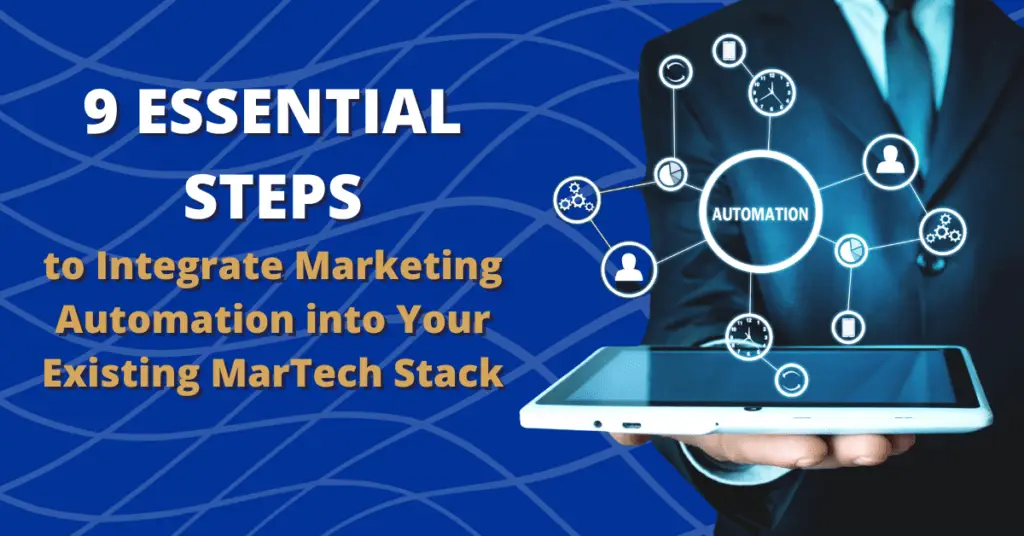
9 Essential Steps to Integrate Marketing Automation into Your Existing MarTech Stack

marketing automation integration

We asked nine experts how a company with an existing martech stack could smoothly integrate marketing automation. Here’s what they told us.

1. Integrate Marketing Automation with Dynamic Reporting

marketing automation integration

Jason Vaught, Director of Content, SmashBrand

You must quantify the impact that marketing automation has on your business. Therefore, integrating marketing automation with a dynamic reporting system improves your workflow because it tells you what’s working and what isn’t. I’d strongly advise that marketers begin by creating a flywheel between their automation and reporting processes to get strong data points that enable optimization and growth.

2. Leverage Middleware for Seamless Integration

I would consider the implementation of middleware. It acts as a software layer, facilitating communication and data management between technologies. Middleware can help integrate marketing automation software with technologies, ensuring data transfer and promoting a smooth workflow among diverse teams.

3. Combine Tools for Personalized Emails

marketing automation integration

Justin Silverman, Founder and CEO, Merchynt

A combination of ClickUp, Zapier, OpenAI, and Gmail is used to send highly personalized welcome emails when a new client signs up and fills out our onboarding form on ClickUp. Highly personalized messages have been launched at scale thanks to the combination of these tools, which significantly aids in creating a better brand experience.

4. Examine Processes for Effective Marketing Automation Integration

Integrating marketing automation with other existing technologies can be achieved by examining your marketing processes. At O+, automation was integrated into our data collection and analysis tools to create a seamless flow of events. This was done to speed up the process and focus more on the actual creation of marketing campaigns, ensuring the best possible experiences for our customers.

This involved a lot of testing to ensure accurate results and valuable data. Once everything was sorted out, it improved our marketing team’s efficiency and enhanced marketing personalization.

5. Use Prompts & Structured Workflows

marketing automation integration

Nick Sforza, Founder and Digital Marketer, Opvital

Integrating marketing automation with other technologies in a company is key to creating a seamless workflow. My advice? Use prompts and structured workflows. Start by mapping out how different technologies – like CRM, analytics, and email marketing tools – interact with each other. Then, establish clear prompts within your automation software to trigger specific actions based on data from these systems. For instance, when a new lead is added to the CRM, the marketing automation tool can be prompted to send a personalized welcome email. By structuring these workflows, every piece of technology works together smoothly, ensuring no opportunities are missed and every interaction with customers is meaningful and timely. This approach has streamlined our processes significantly, making marketing efforts more efficient and effective.

6. Incorporate CRM, AI, & Social Media

marketing automation integration

Samantha Odo, Real Estate Sales Representative and Montreal Division Manager, Precondo

Picture this: CRM integration. Your CRM system is the heart of your operations, right? Now, imagine syncing it with marketing automation. Leads are captured seamlessly, interactions are tracked effortlessly – it’s a match made in tech heaven. You’re not just managing relationships; you’re nurturing them with precision.

Now, let’s sprinkle in a bit of AI. Predictive analytics can be a game-changer. By analyzing data from both marketing automation and CRM, you get insights into future trends and customer behavior. It’s like having a personal assistant whispering, “This is what your clients will love next.”

Email campaigns are the bread and butter of marketing. With automation, you can create personalized journeys based on customer behavior. Now, tie in analytics tools to measure open rates, click-throughs, and conversions. It’s like having a GPS for your emails – guiding you to success.

Oh, and social media! Use automation to schedule posts, track engagements, and keep the conversation flowing.

7. Track Campaigns with Call Analytics

By integrating marketing automation with call-tracking and analytics tools, companies can track the effectiveness of marketing campaigns through phone-call conversions. This often-overlooked approach provides valuable insights into customer interactions. By analyzing call data, companies can optimize marketing efforts and drive better results. For example, a company running a radio-advertisement campaign can use call tracking to measure the number of calls generated by the campaign and the quality of those calls. This data can then be used to fine-tune the advertising strategy, targeting specific radio stations or time slots that generate the highest-converting phone calls.

8. Choose Flexible Platforms for Two-Way Sync

marketing automation integration

Sarah Politi, Founder and Managing Director, Jade & Sterling

Our core strategy revolves around selecting a flexible marketing-automation platform and establishing seamless two-way data sync with key systems, particularly CRM. This integration not only centralizes customer data but also automates lead handovers, ensuring a cohesive transition from marketing to sales. We prioritize personalized customer journeys by leveraging integrated data, tailoring campaigns based on comprehensive insights. By integrating analytics and reporting tools, we provide a holistic view for strategic decision-making. This unified approach extends to integrating communication channels, fostering cross-functional collaboration between marketing, sales, and IT teams. In essence, our focus is on creating an interconnected ecosystem that optimizes efficiency and aligns with overall business objectives.

9. Work Backwards from Your Desired Outcome

The best way to integrate marketing automation with other existing technologies in a company is to first identify the desired outcome, and then work backwards to determine the various steps that are necessary to achieve that outcome. This process often involves mapping the customer journey and identifying the different touchpoints along the way where automation can be used to streamline the workflow. For example, if the desired outcome is to increase sales conversion rates, then it may be helpful to first identify the various ways in which customers interact with the company (e.g., website, emails, social media, etc.). From there, you can identify the different touchpoints along the customer journey where automation can be used to drive conversions (e.g., lead scoring, personalized content, drip campaigns, etc.). By mapping the customer journey and identifying the various touchpoints along the way, you can better understand how automation can be integrated with other existing technologies.

Ready to improve your company’s martech stack through marketing automation integration? Get in touch with us today for expert assistance.

[Sassy_Social_Share]

Related Posts