Quick Takeaways
- Marketo image to email template needs Gen-AI terms first.
- Conversion can take up to five minutes, not seconds.
- Converting an image replaces all content in the email.
- The output is static HTML, so add personalization yourself.
- Brand Themes style templates but do not guarantee compliance.
- Test, proofread and review accessibility before you publish.
Table of Contents
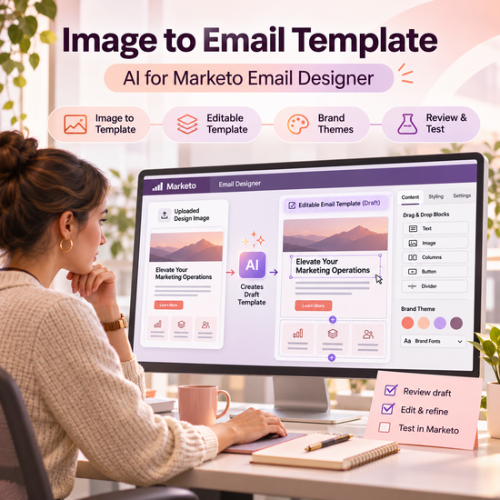
Marketo image to email template conversion turns a PNG or JPEG of an email design into an editable template in the Marketo Email Designer, but it is not instant, and it is not finished when it appears.
Marketing operations teams often hear AI email templates described as a way to skip developers entirely. Adobe’s documentation is more careful: the output is static HTML, text can be misread, complex layouts may not convert accurately, and you still add personalization and tracking yourself.
This guide covers what the feature needs, the steps to convert an image, where Brand Themes fit, what to check afterward and when conversion belongs in your template library.
What the Marketo Image to Email Template Feature Does
The Marketo image to email template feature converts an uploaded image of an email into HTML for the Marketo Email Designer. Adobe’s release notes list it as Email Designer: Image to HTML Converter, and the button in the product reads Convert image to template.
It accepts JPEG and PNG files only. The result is saved as a draft among your Marketo email templates, which you refine in the Marketo Email Designer and then publish. Adobe built it for email templates only, so other content types such as landing pages are not supported. Adobe’s Convert images to HTML templates documentation covers the details.
Availability: In an Experience League Community post on 6 November 2025, an Adobe employee said the feature is available to all Marketo Engage and Journey Optimizer B2B Edition customers at no added charge from 7 November 2025. Adobe’s release notes say features roll out in phases and tell you to check your edition, so confirm access in your own instance.
What You Need Before You Convert
Four things have to be in place before the Marketo image to email template feature will work for your team.
Terms: Agree to Adobe’s Core Gen-AI terms and the supplemental terms for Gen-AI in the Email Designer. Adobe says to contact your Adobe account team for details.
Permissions: Your Marketo role needs Access Email Template and Edit/Generate Email Template.
Image: Use a JPEG or PNG, ideally 600 to 800 pixels wide and high resolution, with clear text and well-defined elements. Include the full email from header to footer in one image, and avoid compressed or low-quality files. Adobe does not state a maximum file size or maximum dimensions.
Existing content: Converting an image replaces all existing content in the email, so save any current work first.
How to Convert an Image to a Marketo Email Template
Adobe documents seven steps, and the whole process runs inside the Marketo Email Designer once the draft is created.
Step 1: In Design Studio, go to Email Templates, then Email Templates (New).
Step 2: Click Convert image to template.
Step 3: Enter a template name, an optional description and optional brand styling, then upload or drag in the image.
Step 4: Select the confirmation checkbox and click Convert.
Step 5: Wait for processing. Adobe says it can take up to five minutes, and you can leave the screen and return later.
Step 6: Open the finished template, which is saved as a draft, in the Email Designer.
Step 7: Edit as needed, then click Save & close and Publish. After publishing, send a test email before you use the template in a live send.
Plan for minutes, not seconds. The Marketo image to email template process is faster than a developer request, but it is not instant, and these AI email templates still need the review described below.
Where Brand Themes Fit
Brand Themes are reusable style sets that apply colors, fonts, spacing and buttons to email templates, emails and fragments. Adobe’s Brand themes documentation lists the limits: up to four variants per theme, one brand theme per email, and no use with Classic mode emails.
On the conversion screen, Adobe mentions only an optional brand styling choice. Adobe’s pages do not describe how that choice interacts with Brand Themes, so test it on a sample image before you rely on it.
To theme an existing template, edit it, open the Themes icon and select Generate theme from content. Marketo detects the existing styling and creates a theme you can name and adjust. Changes to a theme do not update assets that already use it, so each asset must be edited to refresh.
Brand Themes style a template, but they do not review it. Brand compliance across your Marketo email templates still needs a person who checks each result.
What to Check After AI Builds the Template
The AI interprets the image visually, so check these AI email templates the way you would check any new template. Adobe’s documentation points to these reviews:
Text: Verify all text, because the AI may misread it.
Complex layouts: Highly complex layouts may not convert accurately, and simpler designs give better results.
Static HTML: The output is static HTML, so add personalization, dynamic content and tracking yourself.
Rendering: Test across email clients and devices. Adobe recommends its Litmus integration. Our guides to responsive email design and email preview testing cover what to look for.
Accessibility and brand: Review accessibility, brand alignment against your Brand Themes, and styling. Adobe notes that its testing tools are not specifically designed to check full accessibility, so see how AI can help create accessible emails for further checks.
These checks matter most for AI email templates, because a conversion that looks right on screen can still carry a misread word or a missing link.
Where Image to Template Fits in Your Template Library
Image to template works best when a design already exists as an image and you need an editable starting point, such as an agency comp or a screenshot of an approved layout. It is a poor fit when a governed template already covers the layout, because a new conversion adds another template to maintain.
Treat each converted template like any other addition to your Marketo email templates: name it, record its owner, test it, and retire it when a better version replaces it. A separate guide to building, governing and maintaining Marketo email templates will cover that in depth. Decide who may convert images in the Marketo Email Designer and who approves the result, so conversion does not become an unmanaged way to add templates.
Keep brand rules in one place, such as Brand Themes. Our guide to custom email templates explains how brand guidelines become templates, and our post on the new Marketo Engage email editor covers the Marketo Email Designer itself.
Do not confuse conversion with copy generation. Generate content in the Email Designer is a separate AI feature that creates subject lines, sections and full emails from a template, as our review of Marketo’s generative AI email editor explains. Image to template builds the template, and Generate content works inside it. Both depend on your Marketo email templates being sound, so AI email templates need the same governance as any other.
Conclusion
The Marketo image to email template feature gives you an editable starting point, not a finished email. It needs Gen-AI terms and the right permissions, it can take up to five minutes, it replaces existing content, and its static HTML needs your review, personalization and testing. Use it where an image already exists, apply Brand Themes where your team uses them, keep your Marketo email templates governed, and let a person approve every result. If you would like help building a governed template library for your Marketo program, 4Thought Marketing can help.
About 4Thought Marketing
We're a B2B marketing automation and AI consultancy with a thing for getting complex tech to actually work. Since 2008, we've helped hundreds of organizations across financial services, technology, manufacturing, and real estate get more from Eloqua, Marketo, and their CRM integrations. We serve our clients across marketing automation strategy, lead lifecycle, AI, compliance, preference management, and more. Explore our services or get in touch.
Frequently Asked Questions
Is the Marketo image to email template feature included at no extra cost?
An Adobe employee wrote in an Experience League Community post on 6 November 2025 that it is available to all Marketo Engage and Journey Optimizer B2B Edition customers at no added charge from 7 November 2025. Adobe’s release notes say to check your edition, so confirm access in your instance.
How long does the conversion take?
Adobe says processing can take up to five minutes. You can leave the screen and return later, and the finished template is saved as a draft in Email Templates (New).
What file types and sizes does it accept?
JPEG and PNG only. Adobe suggests 600 to 800 pixels wide and high resolution, with the full email from header to footer in one image. Adobe does not state a maximum file size.
Can it convert a hand-drawn sketch?
Adobe’s documentation does not address sketches. In the community post, an Adobe employee reported testing a photo of a skeleton email drawn on paper. Adobe warns that complex or unusual designs may need manual fixes, so test your own sketch first.
Does converting an image replace my existing email content?
Yes. Adobe states that converting an image replaces all existing content in the email, so save any current work before you convert.
What do I still need to add after conversion?
The output is static HTML, so you add personalization, dynamic content and tracking yourself. Verify all text, test across email clients and devices, and review accessibility, brand alignment and styling before you publish your AI email templates.